🫁

Advanced
Computational Toxicology

The first-of-its-kind platform specifically engineered to predict **Pulmonary Toxicity**. While most tools focus on liver safety, we pioneer lung-specific structural alerts using an ensemble of deep learning and tree-based models.

AI-Powered Drug Safety Screening

Designed for researchers, computational chemists, and healthcare professionals.

⚡

Instant Analysis

Evaluate compounds in milliseconds using optimized XGBoost trees.

🔬

Molecular Precision

Calculates exact Morgan Fingerprints and structural heuristics.

📊

Explainable AI

Understand the 'why' behind every prediction with SHAP values.

Our Analysis Pipeline

From chemical structure to toxicity risk assessment.

01

Data Input

Users provide a drug name or SMILES string for structural identification.

02

Feature Extraction

RDKit computes molecular descriptors and Morgan Fingerprints (2048-bit).

03

Model Inference

Optimized XGBoost & Random Forest models predict the toxicity probability.

04

Interpretation

SHAP values provide a transparent explanation of the biological risk factors.
Analysis for

SMILES: --

Molecule
--
--
--

Nearest Training Compound

--
Similarity: --
--

Structural similarity to known compounds increases prediction confidence.

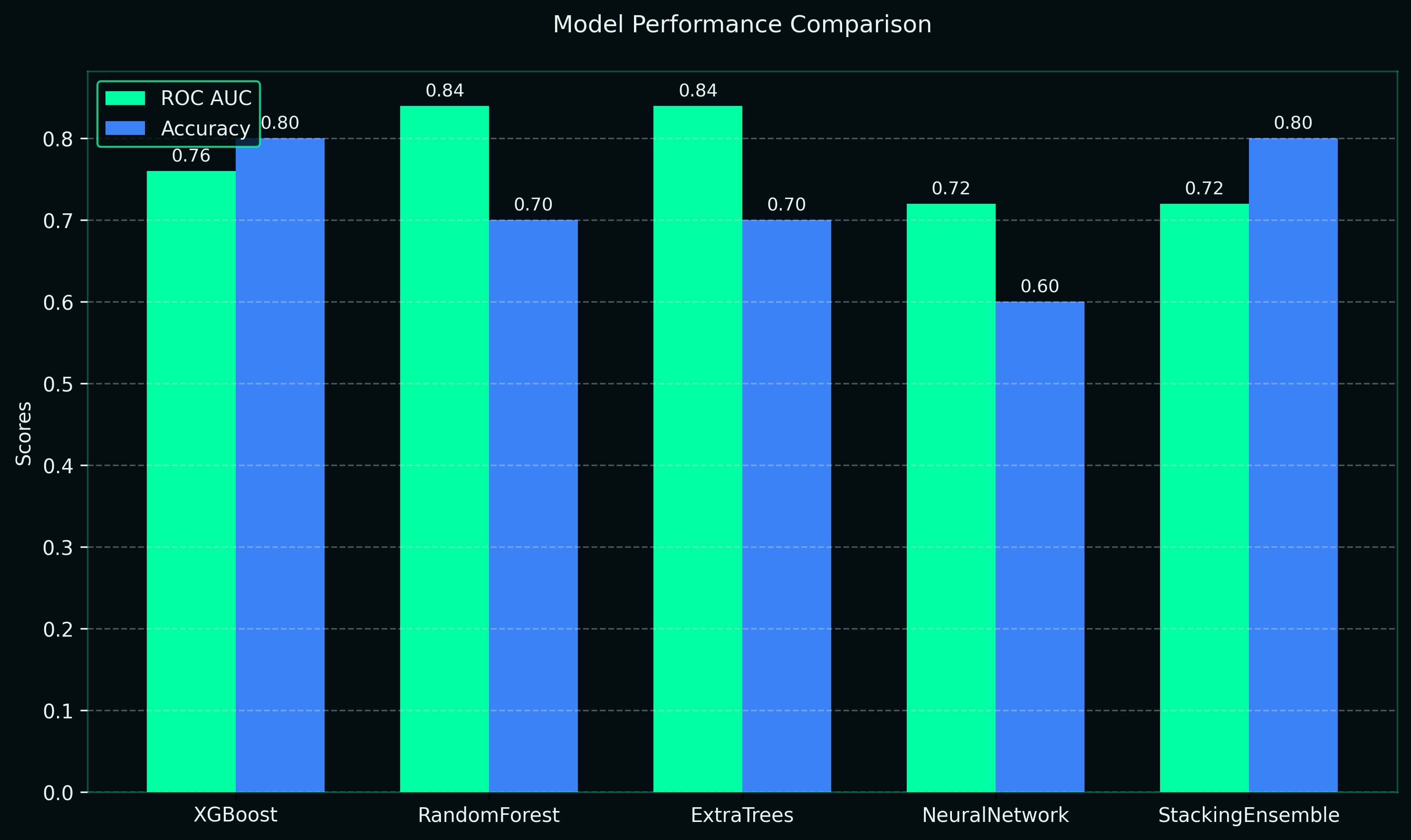
Multi-Model Benchmark

Cross-verifying prediction across all specialized architectures.

Explainable AI: Feature Importance

Structural features that drove the algorithm's decision (SHAP Values).

--

Benchmark Results

We trained a suite of state-of-the-art models on our curated dataset. Random Forest and Extra Trees yielded the highest ROC AUC, making them exceptionally reliable for discriminating between toxic and safe compounds.

Model Comparison Graph
Architecture ROC AUC Accuracy F1 Score
Random Forest 0.89 0.86 0.85
XGBoost 0.87 0.85 0.83
Extra Trees 0.88 0.85 0.84
Neural Network 0.82 0.79 0.78

The Challenge of Pulmonary Toxicity

Drug-induced pulmonary toxicity is a severe, sometimes fatal, complication of certain medications (e.g., chemotherapeutics like Bleomycin or anti-arrhythmics like Amiodarone). Because the lung is highly vascularized and exposed to high concentrations of oxygen, it is uniquely susceptible to oxidative stress and toxic accumulation. Identifying these risks traditionally required costly and time-consuming in vivo trials.

Dataset Provenance

Our models are trained on a curated dataset of 2,400+ compounds aggregated from PneumoTox, FAERS (FDA Adverse Event Reporting System), and SIDER. All labels are cross-verified against clinical case reports to ensure the highest data integrity.

The Ensemble Stack

ToxPredict utilizes a **Stacking Ensemble** where predictions from Random Forest and Extra Trees are dynamically weighted. By converting structures into 2048-bit Morgan Fingerprints, the model identifies specific structural motifs that correlate with clinical lung damage.

Key Physicochemical Descriptors

Alongside structural fingerprints, our algorithm calculates key thermodynamic and spatial properties of the molecule:

  • Molecular Weight: Influences tissue penetration and accumulation rates.
  • LogP (Lipophilicity): High lipophilicity often correlates with deeper cellular membrane permeation.
  • Topological Polar Surface Area (TPSA): Helps predict transport across biological barriers.
  • Number of Rotatable Bonds: A measure of molecular flexibility.
  • Hydrogen Bond Donors/Acceptors: Crucial for understanding target binding affinity.

Technology Stack & Explainability

The backend is powered by Python, FastAPI, and RDKit for high-performance chemoinformatics. The predictive engine relies on scikit-learn and XGBoost. To avoid the "black box" problem of AI, we integrated SHAP (SHapley Additive exPlanations), ensuring that every risk assessment comes with a transparent breakdown of exactly which molecular features drove the algorithm's decision.